Why is manual tweeting outdated and what to use instead?
Ejaz Ahmed
28 Jul 2025 | 6 min read
Back when manual tweeting was just how everyone did things it seemed kind of normal but now it feels really outdated. That approach gets in the way of building reach or getting people to engage more on Twitter/X and it slows down any real growth there.
Other people or competitors are using these advanced tools for Twitter management which leaves the manual stuff looking slow and like you are missing chances all the time plus it's just eating up hours without even giving good info.
Automation for Twitter/X these days along with AI generators for tweets they help boost what humans come up with creatively in a smart way.
The crippling inefficiency of manual tweeting: your time sinkhole
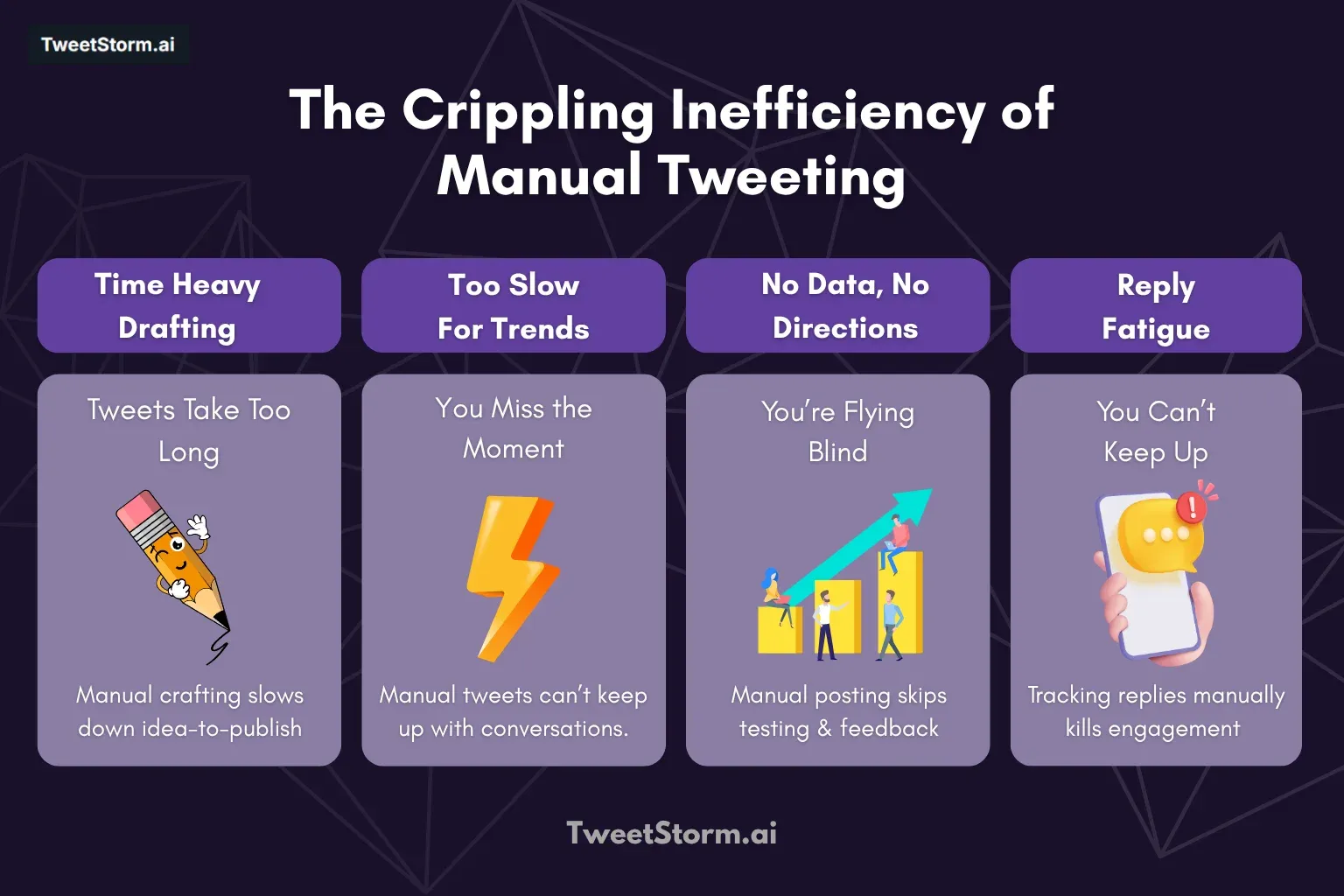
The biggest issue with tweeting manually, comes down to inefficiency that just does not last.
- The draining drafting process: Doing tweets by hand, you know, writing each one from scratch and then editing and formatting it all, that just eats up so much time. It is exhausting in your head too, kind of drains you after a while.
- Missed momentum & real-time relevance: Twitter/X moves fast. Manual tweeting means slow reactions, burying your contributions to trends or discussions. Real-time engagement isn't scalable manually.
- The consistency conundrum: Tweeting consistently seems really important if you want the algorithm to like your stuff and help you grow your followers.
- Operating in the data dark: Doing manual tweeting just makes it hard to track how things are going, you know.
- The reply bottleneck: Real engagement is all about responding fast. Otherwise things just don't pick up.
Manual tweeting wastes time, slows you down, hinders consistency and prevents data-driven improvement, a path to stagnation.
What modern Twitter/X ruthlessly demands (and manual tweeting can't deliver)?
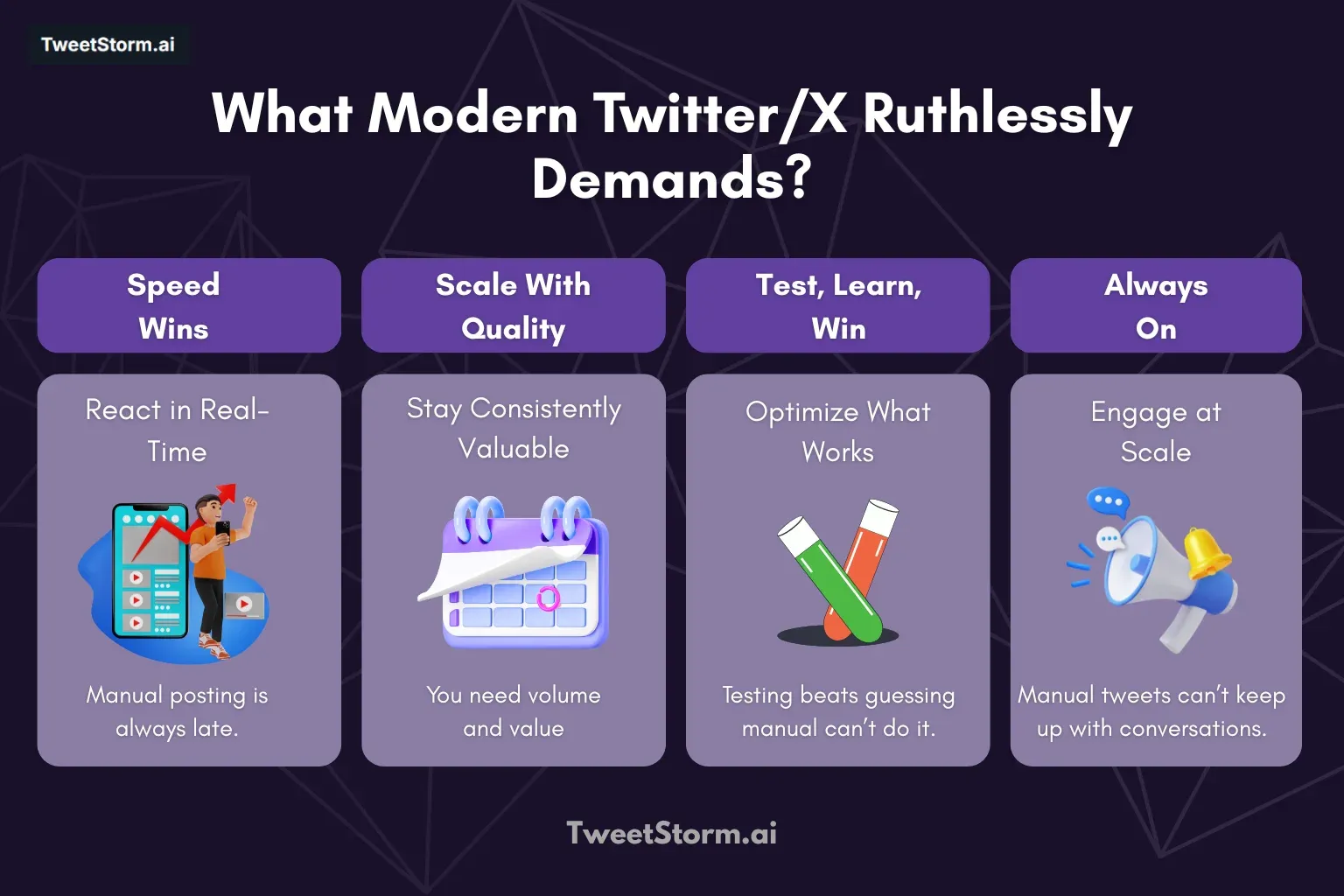
The platform has evolved and so have audience expectations. Winning today requires capabilities that manual processes simply cannot provide:
- Blazing speed & real-time agility: Twitter is really about the moment, you know, what's going on right this second.
- Draft: Rapidly generate relevant tweet concepts or drafts based on emerging trends.
- Post: Schedule or post near-instantly to ride the wave while it's cresting.
- Relentless, high-quality consistency: The algorithm seems to like when you stay active on a regular basis.
- Volume: Keeping a steady flow of tweets, threads and replies going can be tough. You don't want to drop the quality or end up burned out from it all.
- Quality control: Ensuring every tweet, even those scheduled in advance, meets your brand standards and provides value. No filler allowed.
- Cadence: Strategic posting ensures tweets reach your audience when they're most active, not just when you're online.
- Rigorous A/B testing & data-driven optimization: Guessing doesn't cut it. You need to know what works:
- Test variables: Efficiently test hooks, tones (funny/serious), formats (text, poll, image), keywords, hashtags, CTAs and posting times.
- Measure results: Instantly see which variations drive more replies, retweets, clicks, profile visits or follows.
- Iterate rapidly: Use the data to double down on winning formulas and discard what flops. Continuous improvement is non-negotiable.
- Seamless engagement at scale: Building community isn't optional. This requires:
- Timely replies: Acknowledging and responding to comments and questions quickly, even when you're not actively monitoring manually.
- Proactive interaction: Finding relevant conversations to join outside your own mentions.
- Relationship management: Keeping track of key followers, collaborators and influencers.
To succeed on Twitter today, you need speed, consistent volume and quality, data-driven experimentation and scalable engagement. Manual tweeting simply can't deliver this.
Why is "old-school tweeting" a strategic liability?
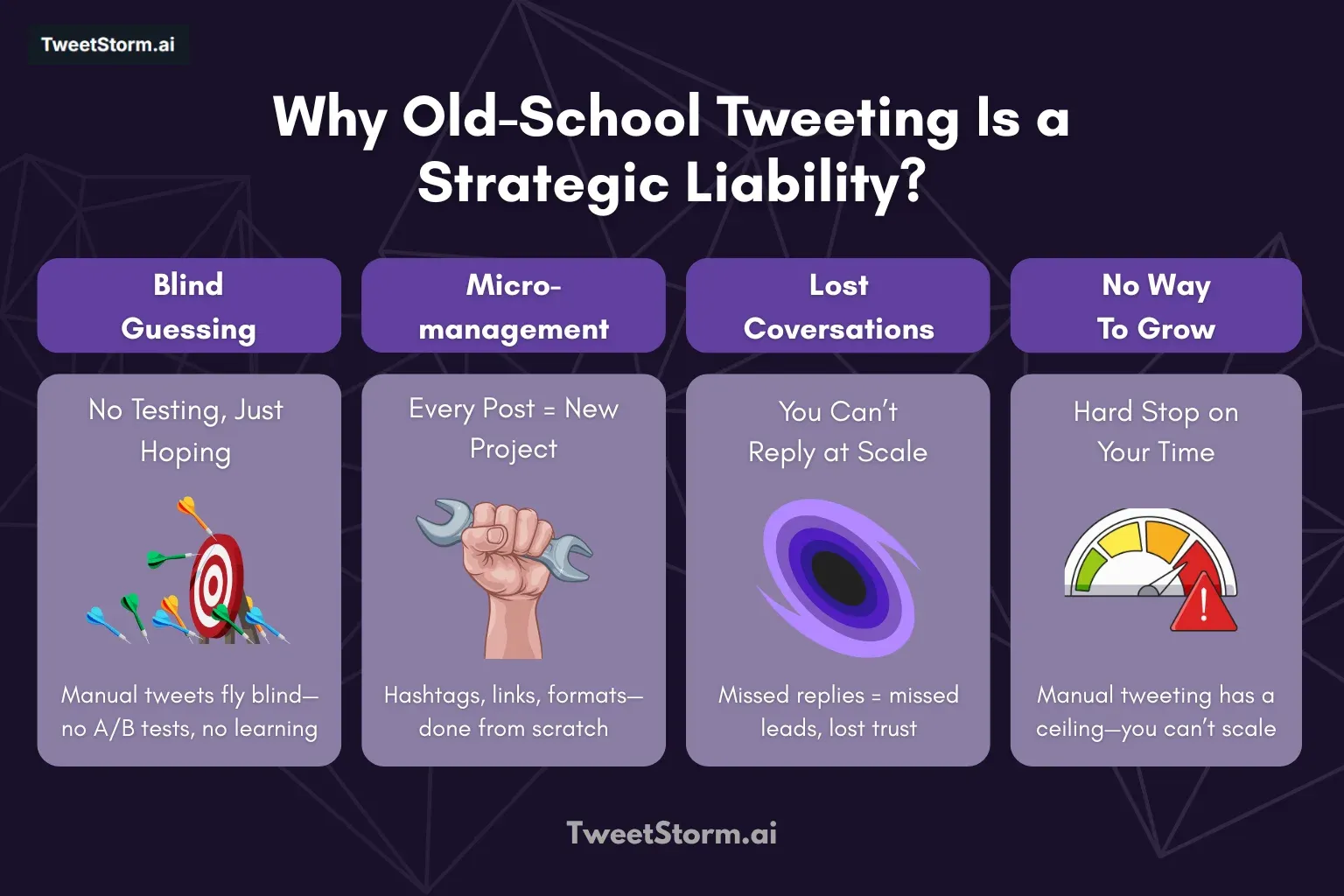
Sticking with manual tweeting, it seems like more than just being slow. It is inefficient for sure.
- Creating in a vacuum: Manual tweeting offers no immediate feedback or rapid testing, forcing reliance on intuition over data.
- The manual optimization grind: Manually optimizing tweets wastes time; focus on strategy and creation instead.
- The engagement black hole: As your growth explodes, manual replies won't suffice. You'll miss vital conversations, leads, fans, problem-solving. Slow replies signal disengagement to users and algorithms.
- Inability to leverage past success: Manually analyzing and repurposing top-performing past tweets is difficult, leading to lost insights.
- Zero scalability: Your growth is limited by time. Manual content creation and conversation management cap your output, leading to an inevitable plateau.
Old-school manual tweeting isn't just slow; it's a strategic dead-end. It prevents you from learning, optimizing, engaging effectively and ultimately, growing beyond a very limited scope.
How TweetStormAI helps you tweet & optimize replies?
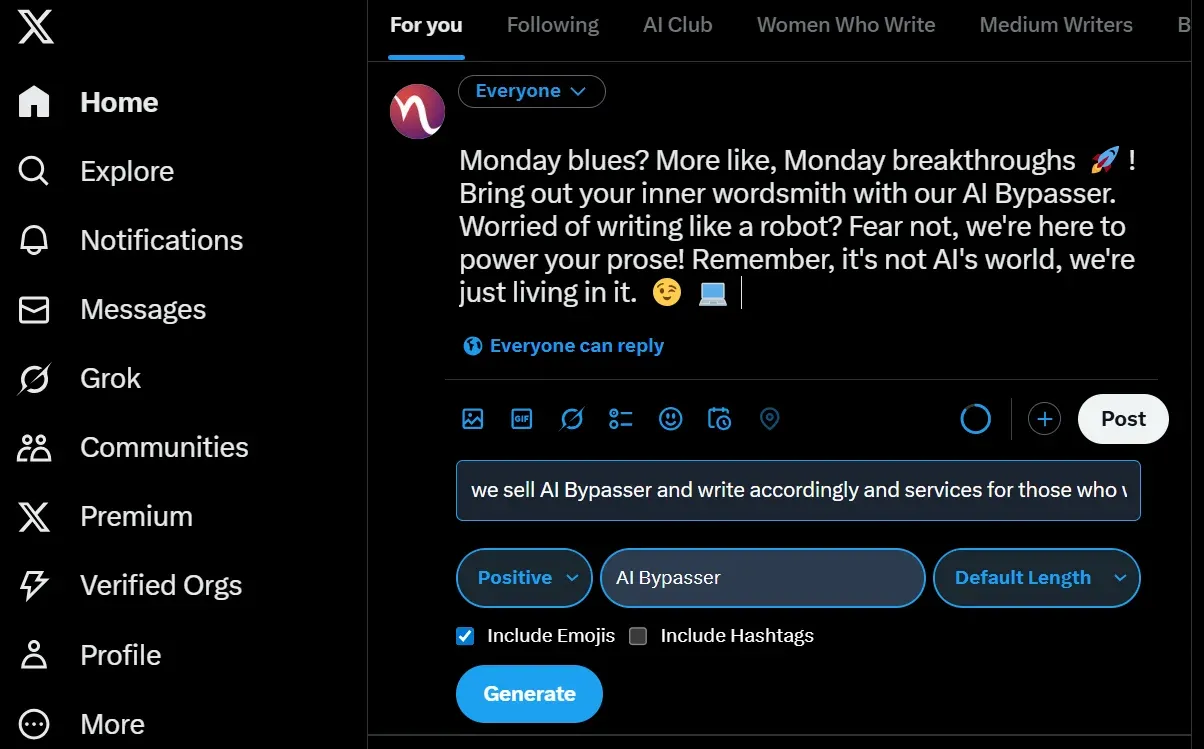
Writing one good reply isn’t hard. Writing 30 a day that actually matches the tone, context and brand voice across threads? That’s where most creators fall short and where TweetStormAI steps in.
This isn’t just a reply tool. It’s a full system for crafting, testing and scaling replies that sound human, without burning out.
Instantly generate reply variations (in 19 tones)
TweetStormAI's Tweet Generator drafts replies in various tones (Sarcastic, Geeky, Casual, Professional), enabling style testing across threads without rewriting.
Whether you're replying to a founder thread or a meme, you can match the mood without forcing it. No more “same voice every time” problem.
Plug in your keywords to stay relevant
TweetStorm's keyword targeting uses custom keywords like "indexing," "web3," or your product name for context-aware, non-robotic replies.
Analyze what’s working (and double down)
Once you’ve posted a few reply variations, it’s easy to scan what’s actually resonating:
- Which tone styles get replies back?
- Which keywords trigger follow-up questions?
- Which replies lead to quote tweets or profile clicks?
Pair TweetStorm with your weekly engagement and suddenly your reply game has data behind it, not just vibes.
Need help tracking past tweet performance? Here’s how to search tweets by date for fast insights.
What makes a tweet reply feel human (even if it's AI-powered)?

The difference between a robotic Twitter reply and a natural one isn’t about who (or what) typed it. It’s about how it reads. Human replies usually follow a few patterns that bots often miss:
- Tone-matching: Real people mirror the vibe of the original tweet, friendly with friendly, sarcastic with sarcastic.
- Topical awareness: A good reply shows the person actually understood the post, not just the keywords.
- Specificity: Generic praise like “Great thread!” gets scrolled past. Specific replies, “Loved that second point about bounce rate!”, spark engagement.
- Natural rhythm: People write with varied sentence lengths, contractions, emojis and even typos.
Final thoughts
Manual tweeting just feels old these days. In this super fast Twitter/X world, everything driven by algorithms, doing it all by hand is not really efficient at all.
TweetStormAI automates human-like tweet replies, eliminating manual inefficiencies. It offers instant reply variations in 19 tones and keyword targeting. This ensures consistent, high-quality content and rapid trend responses while maintaining authenticity.
FAQs
1. Why is manual tweeting no longer effective for Twitter growth?
Manual tweeting just seems inefficient, especially on a platform that moves so fast all the time. It limits how much you can post, makes consistency hard and engagement drops off because of that.
2. What are the downsides of managing tweets manually?
Doing things manually on Twitter just takes up so much time, you know. It is kind of annoying how it leads to posts that are all over the place in timing.
3. How do Twitter automation tools improve engagement?
TweetStormAI is this tool that basically automates stuff on Twitter. It makes sure you keep posting consistent content that's high quality, you know, without having to do it all manually.
4. Can I still sound human using AI to write tweets?
TweetstormAI might be good for something like this. It helps with efficiency a bit and authenticity too.
5. How often should I post on Twitter for best results?
TweetstormAI could work for this kind of thing. It makes things more efficient, at least a little. Like, you save some time on writing.
6. Is it possible to automate tweet replies without sounding robotic?
Yeah, TweetStormAI does this thing where it automatically creates different versions of replies. You can pick from 19 tones. So the responses come out feeling more personal instead of just copy-pasted.
7. How do I track what type of tweet works best?
Tools that have analytics built right in are pretty useful for testing stuff on Twitter, like different hooks for tweets or which hashtags work best.
8. Can I repurpose past tweets with AI tools?
AI tweet generators are pretty useful for going back to your old tweets. You can pick out the ones that did really well, the top performers.
Newsletter
Never miss a post
One email a week with everything new on the TweetStorm blog.